Month: July 2026

  • Heat Stress Prevention Products Market Forecast Reveals Where Future Industry Value Will Be Created

    Heat Stress Prevention Products Market Forecast Reveals Where Future Industry Value Will Be Created

    Through market attractiveness analysis, total addressable market evaluation, company benchmarking matrices, interactive Excel dashboards, expanded supply chain intelligence, emerging startup coverage, and detailed product insights, The Business Research Company’s 2026 market reports provide more actionable and strategically valuable research.

    Heat Stress Prevention Products Market Value Expansion And Long-Term Growth Outlook

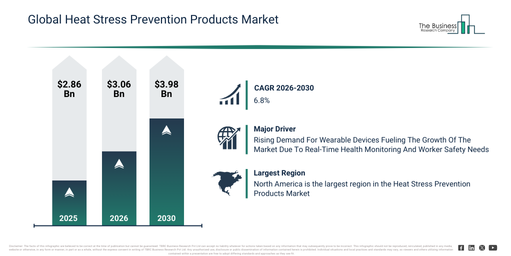
    The market for heat stress prevention products has experienced robust expansion recently. Projections indicate it will expand from $2.86 billion in 2025 to $3.06 billion in 2026, demonstrating a compound annual growth rate (CAGR) of 7.1%. This historical growth is attributable to heightened awareness regarding heat-related health concerns, an increase in occupational health and safety regulations, a greater frequency of extreme heat events, the broadening of industrial and construction sectors, and the growing uptake of safety attire and cooling solutions.

    The heat stress prevention products market size is anticipated to undergo significant expansion in the coming years, reaching $3.98 billion by 2030, with a compound annual growth rate (CAGR) of 6.8%. The projected growth during this period is largely due to escalating global temperatures caused by climate change, increased industrialization in hot regions, more stringent workplace safety regulations, the growing adoption of wearable cooling and monitoring devices, and rising demand from the agriculture and construction sectors. Prominent trends for the forecast period include technological advancements in wearable cooling and monitoring devices, innovations in cooling apparel and personal cooling solutions, the integration of IoT and AI for real-time heat stress monitoring, an increase in smart wearable heat-stress prevention tools, and a growing demand for multifunctional and eco-friendly cooling products.

    Download A Free Sample Report For Comprehensive Market Insights:

    https://www.thebusinessresearchcompany.com/sample.aspx?id=30602&type=smp&utm_source=Blogs&utm_medium=Paid&utm_campaign=Jul_PR

    Heat Stress Prevention Products Market Expansion Drivers: What Is Shaping Future Growth?

    The market for heat stress prevention products is anticipated to expand due to the escalating demand for wearable devices. These electronic gadgets, worn on the body, are designed to monitor health, fitness, or offer smart functionalities. The heightened consumer awareness regarding health drives the demand for wearables, as individuals increasingly aim to track vital signs, enhance fitness, and manage overall well-being. Heat stress prevention products bolster wearable devices through integrated sensors and monitoring systems that continuously track body temperature, hydration, and physiological strain. These products improve worker safety and health by providing timely alerts and actionable insights to avert heat-related ailments. For example, in April 2025, the Parliamentary Office of Science and Technology, a UK parliamentary research and advisory organization, reported that from 2023 to 2024, the National Institute for Health and Care Research (NIHR) and UK Research and Innovation (UKRI) allocated £11.5 million ($15.52 million) to 10 research projects focused on creating wearable technologies for enhancing independence for individuals with frailty or long-term physical disabilities. Consequently, the rising demand for wearable devices is propelling the growth of the heat stress prevention products market.

    #Heat Stress Prevention Products Market Segment Landscape And Growth Potential

    The heat stress prevention products market covered in this report is segmented –

    1) By Product Type: Cooling Wearables And Apparel, Hydration And Electrolyte Solutions, Environmental Heat Reduction Products, Personal Cooling Devices, Monitoring And Safety Devices

    2) By Technology: Passive Cooling, Active Cooling, Insulative Or Reflective, Smart Or Connected, Hydration Optimization

    3) By Distribution Channel: Business-To-Business (B2B), Business-To-Consumer (B2C)

    4) By End-User: Industrial Or Occupational, Sports And Recreation, Military And First Responders, Healthcare, General Consumer

    Subsegments:

    1) By Cooling Wearables And Apparel: Cooling Vest, Cooling Shirt, Cooling Jacket, Cooling Gloves, Cooling Hat

    2) By Hydration And Electrolyte Solutions: Oral Rehydration Solution, Electrolyte Drink Mix, Ready To Drink Electrolyte Beverage, Electrolyte Powder Sachets, Electrolyte Tablets

    3) By Environmental Heat Reduction Products: Shade Structures, Ventilation Fans, Evaporative Cooling Systems, Air Cooling Units, Reflective Shelters

    4) By Personal Cooling Devices: Battery Powered Cooling Vest, Personal Fan, Neck Cooler, Cooling Bandana, Cooling Wristband

    5) By Monitoring And Safety Devices: Body Temperature Sensor Device, Heat Exposure Alert Wearable, Hydration Reminder Device, Heart Rate Monitor Wearable, Environmental Heat Index Monitor

    Heat Stress Prevention Products Market Competitive Landscape: Who Are The Leading Companies?

    Major companies operating in the heat stress prevention products market are Symphony Limited, Radians Inc., Ergodyne Inc., Honeywell Safety Products, Thermoteknix Systems Ltd., Encon Safety Products Inc., TechNiche International, Allegro Industries Inc., COOLSHIRT Systems LLC, i2Cool Technology Inc., Climacool, Coolcore LLC, Polar Products Inc., Evalan GmbH, StaCool Industries, Arctic Heat Pty Ltd., CoolVest Inc., CoolPax Systems, Glacier Tek Inc., Bodytrak Inc.

    Access The Complete Heat Stress Prevention Products Market Report:

    https://www.thebusinessresearchcompany.com/report/heat-stress-prevention-products-market-report?utm_source=Blogs&utm_medium=Paid&utm_campaign=Jul_PR

    Heat Stress Prevention Products Market Regional Outlook: Where Are The Largest Opportunities Located?

    North America was the largest region in the heat stress prevention products market in 2025. Asia-Pacific is expected to be the fastest-growing region in the forecast period. The regions covered in the heat stress prevention products market report are Asia-Pacific, South East Asia, Western Europe, Eastern Europe, North America, South America, Middle East, Africa.

    Get in touch with us:

    The Business Research Company: https://www.thebusinessresearchcompany.com/

    Americas: +1 310-496-7795

    Asia: +44 7882 955267 & +91 8897263534

    Europe: +44 7882 955267

    Email us at: marketing@tbrc.info

    Follow us on:

    LinkedIn: https://in.linkedin.com/company/the-business-research-company

    YouTube: https://www.youtube.com/channel/UC24_fI0rV8cR5DxlCpgmyFQ

    Global Market Model: https://www.thebusinessresearchcompany.com/global-market-model
  • Hand Hygiene Stations Market Growth Outlook Reveals A CAGR Of 11.4% And A Market Value Of $3.92 Billion By 2030

    Hand Hygiene Stations Market Growth Outlook Reveals A CAGR Of 11.4% And A Market Value Of $3.92 Billion By 2030

    Through market attractiveness analysis, total addressable market evaluation, company benchmarking matrices, interactive Excel dashboards, expanded supply chain intelligence, emerging startup coverage, and detailed product insights, The Business Research Company’s 2026 market reports provide more actionable and strategically valuable research.

    Hand Hygiene Stations Market Growth From $2.55 Billion In 2026 To $3.92 Billion By 2030 At A CAGR Of 11.4%

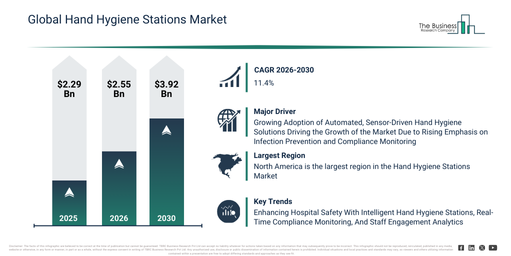
    The hand hygiene stations market size has experienced rapid expansion in recent years. It is anticipated to increase from $2.29 billion in 2025 to $2.55 billion in 2026, demonstrating a compound annual growth rate (CAGR) of 11.6%. The historical growth of this market can be attributed to increasing public awareness about hand hygiene, the growing adoption of automatic dispensers, rising demand in healthcare facilities, the expansion of commercial and educational infrastructure, and an increasing focus on infection prevention.

    The hand hygiene stations market is projected for substantial expansion over the upcoming years. It is anticipated to reach $3.92 billion by 2030, exhibiting a compound annual growth rate (CAGR) of 11.4%. This anticipated growth during the forecast period stems from factors such as the increasing embrace of touchless and smart hygiene stations, rising investment in sanitation infrastructure, a greater call for portable and wall-mounted units, the broadening of hygiene compliance programs, and a significant surge in the deployment of sensor-activated dispensers. Key trends identified for the forecast timeframe encompass technological improvements in automatic dispensers, novelties in touchless and smart systems, progress in eco-friendly and refillable units, ongoing research and development for high-capacity sanitizer stations, and progress in digital monitoring and usage tracking.

    Download A Free Sample Report For Comprehensive Market Insights:

    https://www.thebusinessresearchcompany.com/sample.aspx?id=30599&type=smp&utm_source=Blogs&utm_medium=Paid&utm_campaign=Jul_PR

    #Hand Hygiene Stations Market Growth Factors: Which Forces Are Supporting Market Expansion?

    The anticipated expansion of the hand hygiene stations market is attributed to the increasing uptake of automated, sensor-driven hand hygiene solutions. These advanced solutions encompass electronic dispensers equipped with motion sensors, systems for badge-based tracking, and compliance analytics, all designed to offer real-time oversight and feedback regarding hand hygiene practices. The rising use of automated, sensor-driven hand hygiene solutions stems from a heightened focus by healthcare systems and public health authorities on achieving measurable and consistent hand hygiene to mitigate healthcare-associated infections and enhance patient safety. Hand hygiene stations facilitate these automated, sensor-driven solutions by incorporating sophisticated technologies that allow for precise tracking, administration, and reporting of hygiene conduct in medical and public environments. For example, a report in September 2024 from The Leapfrog Group, a US-based nonprofit organization, indicated that the implementation of electronic hand hygiene monitoring systems within U.S. hospitals reached 10% by 2023, signifying a twofold increase in the utilization of sensor-enabled compliance instruments. Consequently, the expanding deployment of automated, sensor-driven solutions is a key factor propelling the development of the hand hygiene stations market.

    Hand Hygiene Stations Market Segmentation And Category Breakdown

    The hand hygiene stations market covered in this report is segmented –

    1) By Product Type: Automatic Hand Sanitizer Dispensers, Manual Hand Sanitizer Dispensers, Touchless Hand Hygiene Stations, Wall-Mounted Hand Sanitizer Units, Portable Hand Hygiene Stations, Hand Sanitizer Kiosks

    2) By Portability And Installation: Permanent And Fixed Stations, Portable And Temporary Stations

    3) By Technology: Sensor-Activated Dispensers, Manual Dispensers, Smart And Connected Dispensers

    4) By Distribution Channel: Direct Sales From Manufacturers, Distributors And Wholesalers, Online Retail And E Commerce, Specialized Medical And Janitorial Suppliers

    5) By End User: Healthcare Facilities And Hospitals, Corporate Offices And Commercial Buildings, Educational Institutions, Hospitality And Food Service Establishments, Retail Stores And Shopping Malls

    Subsegments:

    1) By Automatic Hand Sanitizer Dispensers: Sensor-Activated Models, Foot-Pedal Models, Countertop Models, Rechargeable Battery Models, Large-Capacity Models

    2) By Manual Hand Sanitizer Dispensers: Lever-Operated Models, Push-Button Models, Countertop Manual Models, Wall-Mounted Manual Models, Refillable Cartridge Models

    3) By Touchless Hand Hygiene Stations: Infrared Sensor Stations, Ultrasonic Sensor Stations, Foot-Activated Touchless Stations, Fully Automated Hygiene Booths, Motion-Activated Stations

    4) By Wall-Mounted Hand Sanitizer Units: Plastic Wall-Mounted Units, Stainless Steel Wall-Mounted Units, Refillable Wall-Mounted Units, Lockable Wall-Mounted Units, Compact Wall-Mounted Units

    5) By Portable Hand Hygiene Stations: Mobile Stand Units, Outdoor Portable Stations, Battery-Powered Portable Stations, Foldable Portable Units, High-Capacity Portable Stations

    6) By Hand Sanitizer Kiosks: Digital Display Kiosks, Temperature Screening Kiosks, Advertising Panel Kiosks, Automated Refill Kiosks, Free-Standing Kiosks

    Hand Hygiene Stations Market Industry Trends: What Changes Are Reshaping Demand?

    Companies actively engaged in the hand hygiene stations market are prioritizing the development of sophisticated solutions, such as real-time compliance tracking and staff interaction tools. These advancements aim to enhance infection control, improve adherence to hygiene protocols, and provide actionable insights into healthcare operations. Real-time compliance monitoring and staff engagement tools represent integrated systems designed to observe hand hygiene behaviors across facilities, deliver immediate feedback to healthcare personnel, and offer analytics to support continuous improvement and risk reduction. For instance, in July 2024, Kontakt.io Inc., a US-based healthcare technology company, unveiled a next-generation hand hygiene solution crafted to revolutionize how hospitals manage compliance and engage staff. This fully cloud-based system, provided as a managed service, employs a patented method involving the Staff-Safe-enabled Smart Badge 3 wearable to deliver subtle, proactive reminders before patient care without disrupting workflow. It further includes compliance gamification through a mobile application and automated dispenser management, allowing for seamless monitoring and maintenance without manual intervention. The solution also integrates interaction-based contact tracing and simplified audit reporting, thereby increasing its value for infection prevention teams and contributing to reduced operational costs for healthcare systems.

    Hand Hygiene Stations Market Competitive Analysis Of Major Industry Participants

    Major companies operating in the hand hygiene stations market are GOJO Industries Inc., American Specialties Inc., Hagleitner Hygiene International GmbH, Bobrick Washroom Equipment Inc., Frontmatec Group A/S, Kutol Products Company Inc., Dolphy India Pvt. Ltd., Elpress AB, NIEROS Group d.o.o., Hokwang Industries Co. Ltd., Technocrat Enterprises, Nexgen Machines Pvt. Ltd., Mohn GmbH, Meritech Systems LLC, Heim-EDT GmbH, Technsys Cleanroom Solutions Pvt. Ltd., Delta Pyramax Co. Ltd., SMIXIN AG, Sanair Systems Pvt. Ltd., Wone Hygiene Systems Pvt. Ltd.

    Access The Complete Hand Hygiene Stations Market Report:

    https://www.thebusinessresearchcompany.com/report/hand-hygiene-stations-market-report?utm_source=Blogs&utm_medium=Paid&utm_campaign=Jul_PR

    Hand Hygiene Stations Market Regional Analysis: Which Region Leads By Revenue?

    North America was the largest region in the hand hygiene stations market in 2025. Asia-Pacific is expected to be the fastest-growing region in the forecast period. The regions covered in the hand hygiene stations market report are Asia-Pacific, South East Asia, Western Europe, Eastern Europe, North America, South America, Middle East, Africa.

    Get in touch with us:

    The Business Research Company: https://www.thebusinessresearchcompany.com/

    Americas: +1 310-496-7795

    Asia: +44 7882 955267 & +91 8897263534

    Europe: +44 7882 955267

    Email us at: marketing@tbrc.info

    Follow us on:

    LinkedIn: https://in.linkedin.com/company/the-business-research-company

    YouTube: https://www.youtube.com/channel/UC24_fI0rV8cR5DxlCpgmyFQ

    Global Market Model: https://www.thebusinessresearchcompany.com/global-market-model
  • Digital Neuro Biomarkers Market Expansion Is Reshaping Competitive Dynamics Across The Industry

    Digital Neuro Biomarkers Market Expansion Is Reshaping Competitive Dynamics Across The Industry

    Delivering more actionable and strategically valuable research, The Business Research Company’s 2026 market reports feature market attractiveness analysis, total addressable market evaluation, company benchmarking matrices, interactive Excel dashboards, expanded supply chain intelligence, emerging startup coverage, and detailed product insights.

    Digital Neuro Biomarkers Market Expansion From $1.22 Billion In 2026 To $3.19 Billion In 2030

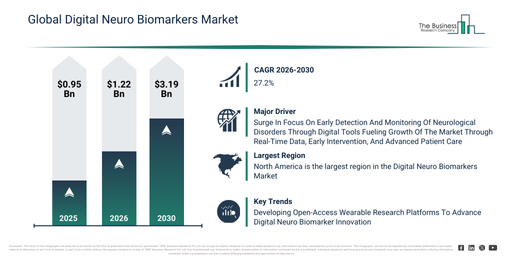
    The digital neuro biomarkers market size has observed significant expansion in recent years. It is forecast to grow from $0.95 billion in 2025 to $1.22 billion in 2026, achieving a compound annual growth rate (CAGR) of 27.5%. The historical growth of this market stems from factors such as the increasing prevalence of neurological disorders, the rising adoption of wearable devices, a stronger focus on cognitive assessment, advancements in neuroimaging technologies, and early research endeavors in digital biomarker development.

    The digital neuro biomarkers market is expected to experience significant growth over the next few years. It is projected to expand to $3.19 billion by 2030, achieving a compound annual growth rate (CAGR) of 27.2%. This growth during the forecast period is attributable to the increasing incorporation of artificial intelligence in neurological diagnostics, a rising demand for remote patient monitoring, the broadening of tele-neurology services, increased investments in neuroscience research, and the development of personalized neurology treatment solutions. Key trends in the upcoming period include the enhanced utilization of cloud-based neurological data analytics, the adoption of real-time brain monitoring technologies, the proliferation of mobile cognitive assessment applications, the integration of machine learning in biomarker analysis, and the rise of predictive and precision neurology platforms.

    Download A Free Sample Report For Comprehensive Market Insights:

    https://www.thebusinessresearchcompany.com/sample.aspx?id=30571&type=smp&utm_source=Blogs&utm_medium=Paid&utm_campaign=Jul_PR

    #Digital Neuro Biomarkers Market Demand Drivers Creating New Revenue Opportunities

    The heightened emphasis on the early detection and continuous monitoring of neurological disorders is expected to drive the growth of the digital neuro biomarkers market. This involves the utilization of digital technologies like wearable devices, mobile applications, and sensors to continuously assess neurological function, cognition, and behavior, thereby enabling the timely identification of neurological conditions. This focus is intensifying due to various public health initiatives and clinical priorities aimed at identifying cognitive impairment and neurodegenerative diseases before severe symptoms manifest. Digital neuro biomarkers support these efforts by providing objective, real-time data that assists clinicians and researchers in detecting subtle neurological changes and initiating early interventions. For instance, in 2024, the U.S. Centres for Disease Control and Prevention’s Healthy Brain Initiative highlights that neurological disorders affect approximately one billion people globally, including around 50 million individuals with epilepsy and 24 million with Alzheimer’s disease. Therefore, the increasing focus on the early detection and monitoring of neurological disorders through digital tools is propelling the expansion of the digital neuro biomarkers market.

    Digital Neuro Biomarkers Market Segment Landscape: Which Areas Lead Market Development?

    The digital neuro biomarkers market covered in this report is segmented –

    1) By Type: Wearable, Mobile-Based Applications, Sensors, Other Types

    2) By Deployment Mode: Cloud-Based Platforms, On-Premise Platforms, Hybrid Deployment Models

    3) By Biomarker Type: Cognitive Digital Biomarkers, Motor Function Digital Biomarkers, Speech And Language Digital Biomarkers, Behavioral Digital Biomarkers

    4) By End-User: Healthcare Companies, Healthcare Providers, Payers, Other End-Users

    Subsegments:

    1) By Wearable: Smart Wristbands, Smart Headbands, Smart Watches, Smart Clothing, Implantable Devices

    2) By Mobile-Based Applications: Cognitive Assessment Applications, Neurological Monitoring Applications, Mental Health Tracking Applications, Motor Function Assessment Applications, Speech And Language Tracking Applications

    3) By Sensors: Electroencephalography Sensors, Electrocardiography Sensors, Eye Tracking Sensors, Motion Tracking Sensors, Biometric Monitoring Sensors

    4) By Other Types: Cloud Based Platforms, Data Analytics Tools, Digital Therapeutic Platforms, Artificial Intelligence Enabled Assessment Tools, Virtual Reality Based Assessment Tools

    Digital Neuro Biomarkers Market Trends Driving Strategic Industry Expansion

    Leading companies in the digital neuro biomarkers market are prioritizing the creation of open-access research infrastructure, such as WearGait PD, to facilitate the development, validation, and regulatory assessment of wearable-based digital neuro biomarkers for neurological disorders. WearGait PD is defined as a regulatory science dataset that offers synchronized wearable sensor and gait data from individuals with Parkinson’s disease and age-matched controls, making it possible to extract and evaluate gait-derived digital biomarkers for disease monitoring and progression evaluation. For example, in July 2024, the U.S. Food and Drug Administration (FDA), a U.S.-based regulatory agency, released “WearGait PD: Wearables Dataset for Gait in Parkinson’s Disease and Age-Matched Controls,” an open-access dataset intended to support researchers and industry developers in deriving and validating digital biomarkers. The dataset contains raw inertial measurement unit (IMU) acceleration and rotational velocity data, insole pressure recordings, and synchronized gait annotations, which aids in algorithm testing, metric validation, and the advancement of wearable sensor-based monitoring tools.

    Digital Neuro Biomarkers Market Industry Leaders And Market Competition

    Major companies operating in the digital neuro biomarkers market are F. Hoffmann-La Roche AG, Merck KGaA, Biogen Inc., Evidation Health Inc., Huma Therapeutics Limited, Altoida Inc, Cogstate Limited, Quibim S.L., Empatica Inc., Linus Health Inc., Cambridge Cognition Holdings plc, Brainomix Limited, Mindstrong Health Inc., Neurotrack Technologies Inc., Feel Therapeutics Inc., BrainCheck Inc., IXICO plc, NeuraMetrix Inc., NeuraLight Ltd., Koneksa Health Inc., Sonde Health Inc., Aural Analytics Inc., Winterlight Labs Inc.

    Access The Complete Digital Neuro Biomarkers Market Report:

    https://www.thebusinessresearchcompany.com/report/digital-neuro-biomarkers-market-report?utm_source=Blogs&utm_medium=Paid&utm_campaign=Jul_PR

    Digital Neuro Biomarkers Market Regional Distribution: Which Areas Drive Market Expansion?

    North America was the largest region in the digital neuro biomarkers market in 2025. Asia-Pacific is expected to be the fastest-growing region in the forecast period. The regions covered in the digital neuro biomarkers market report are Asia-Pacific, South East Asia, Western Europe, Eastern Europe, North America, South America, Middle East, Africa.

    Get in touch with us:

    The Business Research Company: https://www.thebusinessresearchcompany.com/

    Americas: +1 310-496-7795

    Asia: +44 7882 955267 & +91 8897263534

    Europe: +44 7882 955267

    Email us at: marketing@tbrc.info

    Follow us on:

    LinkedIn: https://in.linkedin.com/company/the-business-research-company

    YouTube: https://www.youtube.com/channel/UC24_fI0rV8cR5DxlCpgmyFQ

    Global Market Model: https://www.thebusinessresearchcompany.com/global-market-model
  • Deoxyribonucleic Acid (DNA)–Based Personalized Nutrition Kit Market Growth Through 2030 Creates New Strategic Opportunities

    Deoxyribonucleic Acid (DNA)–Based Personalized Nutrition Kit Market Growth Through 2030 Creates New Strategic Opportunities

    Through market attractiveness analysis, total addressable market evaluation, company benchmarking matrices, interactive Excel dashboards, expanded supply chain intelligence, emerging startup coverage, and detailed product insights, The Business Research Company’s 2026 market reports provide more actionable and strategically valuable research.

    Deoxyribonucleic Acid (DNA)–Based Personalized Nutrition Kit Market Revenue Growth Supported By A CAGR Of 4.23% Through 2030

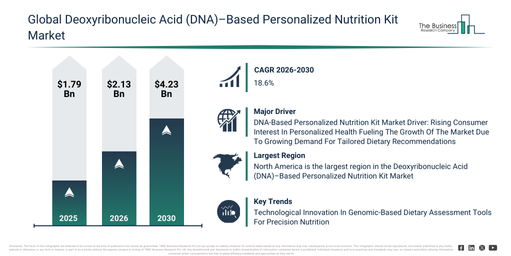
    The DNA-based personalized nutrition kit market size has seen swift expansion over recent years. It is projected to expand from $1.79 billion in 2025 to $2.13 billion in 2026, achieving a compound annual growth rate (CAGR) of 18.9%. This historical growth can be attributed to several factors: increasing consumer fascination with personalized nutrition, the wider uptake of direct-to-consumer DNA testing, a heightened understanding of genetic predispositions to diet-related ailments, the broader availability of economical genetic testing kits, and the greater integration of nutritional insights into various wellness programs.

    The DNA-based personalized nutrition kit market is anticipated to experience substantial growth over the next few years. Its valuation is projected to reach $4.23 billion by 2030, demonstrating a compound annual growth rate (CAGR) of 18.6%. This expansion during the forecast period is propelled by factors such as an increasing need for precision health solutions, the rising adoption of AI-based nutrition recommendations, a heightened focus on preventive healthcare, the expanding availability of advanced genomic analysis platforms, and a notable consumer inclination towards personalized wellness products. Significant trends expected in this period include ongoing advancements in bioinformatics and genetic interpretation tools, novel developments in multi-omics-based nutrition solutions, the creation of integrated digital nutrition platforms, continued research and development in nutrigenomics applications, and the emergence of real-time AI-powered personalized diet planning tools.

    Download A Free Sample Report For Comprehensive Market Insights:

    https://www.thebusinessresearchcompany.com/sample.aspx?id=30569&type=smp&utm_source=Blogs&utm_medium=Paid&utm_campaign=Jul_PR

    #Deoxyribonucleic Acid (DNA)–Based Personalized Nutrition Kit Market Growth Drivers And Industry Catalysts

    An increasing consumer focus on tailored health solutions is projected to fuel the expansion of the deoxyribonucleic acid (DNA)-based personalized nutrition kit market. This personalized health concept involves a healthcare and wellness methodology that customizes prevention plans, therapies, dietary advice, and lifestyle suggestions according to a person’s distinct attributes, including their genetic profile, biological markers, medical background, surroundings, and habits, with the aim of enhancing health results and overall welfare. Progress in genomic sequencing technology is fostering this increased consumer interest by rendering genetic information more readily available, cost-effective, and practical for daily health and eating choices. Deoxyribonucleic acid (DNA)-based personalized nutrition kits capitalize on these innovations by examining individual genetic indicators to create bespoke dietary programs, suggesting particular nutrient consumption and food selections that match a person’s metabolic characteristics. Increasing public involvement in genomic studies further reinforces this pattern. For example, as reported by the National Institutes of Health, a US-based medical research body, in January 2025, the All of Us Research Program had registered over 832,000 participants by August 24, 2024, with more than 566,000 participants having finished the program’s initial stages. Furthermore, in September 2024, the program broadened its researcher workbench data, expanding the total number of participants from 413,000 to 633,000, which marks a 53% rise. Consequently, the growing consumer demand for personalized health is propelling the expansion of the deoxyribonucleic acid (DNA)-based personalized nutrition kit market.

    Deoxyribonucleic Acid (DNA)–Based Personalized Nutrition Kit Market Segment Analysis: What Are The Major Market Categories?

    The deoxyribonucleic acid (dna)–based personalized nutrition kit market covered in this report is segmented –

    1) By Product Type: Test Kits, Analysis Services, Supplements, Other Product Types

    2) By Sample Type: Saliva, Blood, Buccal Swab, Other Sample Types

    3) By Distribution Channel: Online, Pharmacies, Wellness Centers, Other Distribution Channels

    4) By Application: Weight Management, Sports Nutrition, Digestive Health, Chronic Disease Management, Other Applications

    5) By End-User: Individuals, Healthcare Professionals, Fitness Centers, Other End-Users

    Subsegments:

    1) By Test Kits: Genetic Testing Kits, Nutrigenomic Testing Kits, Diet Response Testing Kits, Metabolic Function Testing Kits, Wellness Assessment Kits

    2) By Analysis Services: Genetic Data Interpretation Services, Personalized Nutrition Planning Services, Health Risk Assessment Services, Diet Optimization Services, Lifestyle Recommendation Services

    3) By Supplements: Personalized Vitamin Supplements, Personalized Mineral Supplements, Personalized Probiotic Supplements, Personalized Herbal Supplements, Personalized Amino Acid Supplements

    4) By Other Product Types: Personalized Meal Plans, Nutritional Coaching Programs, Mobile Health Applications, Genetic Wellness Reports, Lifestyle Modification Guides

    #Deoxyribonucleic Acid (DNA)–Based Personalized Nutrition Kit Market Trends Influencing Long-Term Demand

    Leading companies within the deoxyribonucleic acid (DNA)-based personalized nutrition kit market are increasingly prioritizing technological innovation, particularly the creation of advanced dietary assessment tools that merge genetic data with real-time food consumption analysis. These advancements aim to overcome the limitations of static genetic reports by connecting long-term genetic predispositions with users’ daily eating habits. By comparing actual nutritional intake against genetically informed dietary requirements, these instruments empower users to pinpoint specific nutrient deficits and receive practical, food-centric recommendations applicable to everyday living. For instance, in October 2025, GenoPalate Inc., a US-based genomic nutrition company, announced the launch of Diet Snapshot, a food frequency questionnaire integrated into its platform. This feature evaluates a member’s current diet and contrasts it with personalized nutritional targets derived from hundreds of genetic variants and lifestyle inputs. By identifying actionable strategies to bridge nutrient gaps through particular food choices, the tool enhances the personalization of GenoVit multivitamin formulations, ensuring members receive precise nutrient dosages aligned with their biological requirements and lifestyle.

    Deoxyribonucleic Acid (DNA)–Based Personalized Nutrition Kit Market Leading Companies Driving Competitive Growth

    Major companies operating in the deoxyribonucleic acid (dna)–based personalized nutrition kit market are 23andMe Inc., Viome Life Sciences Inc., VitaGene Inc., ORIG3N Inc., Helix OpCo Inc., MapmyGenome Pvt. Ltd., DNAlysis Biotechnology, InsideTracker Inc., Nutrigenomix Inc., Pathway Genomics, 3X4 Genetics Inc., FitnessGenes Ltd., Gene by Gene Ltd., Gene Food Inc., Genomelink Inc., GenoPalate Inc., Life X DNA, LifeDNA Inc., myDNA Life Pty Ltd., Xcode Life

    Access The Complete Deoxyribonucleic Acid (DNA)–Based Personalized Nutrition Kit Market Report:

    https://www.thebusinessresearchcompany.com/report/deoxyribonucleic-acid-dna-based-personalized-nutrition-kit-market-report?utm_source=Blogs&utm_medium=Paid&utm_campaign=Jul_PR

    Deoxyribonucleic Acid (DNA)–Based Personalized Nutrition Kit Market Regional Outlook: Where Are The Largest Opportunities Located?

    North America was the largest region in the DNA-based personalized nutrition kit market in 2025. Asia-Pacific is expected to be the fastest-growing region in the forecast period. The regions covered in the deoxyribonucleic acid (dna)–based personalized nutrition kit market report are Asia-Pacific, South East Asia, Western Europe, Eastern Europe, North America, South America, Middle East, Africa.

    Get in touch with us:

    The Business Research Company: https://www.thebusinessresearchcompany.com/

    Americas: +1 310-496-7795

    Asia: +44 7882 955267 & +91 8897263534

    Europe: +44 7882 955267

    Email us at: marketing@tbrc.info

    Follow us on:

    LinkedIn: https://in.linkedin.com/company/the-business-research-company

    YouTube: https://www.youtube.com/channel/UC24_fI0rV8cR5DxlCpgmyFQ

    Global Market Model: https://www.thebusinessresearchcompany.com/global-market-model
  • Cognitive Neuroscience Market Growth Is Reshaping Competitive Advantage Across The Industry

    Cognitive Neuroscience Market Growth Is Reshaping Competitive Advantage Across The Industry

    Through market attractiveness analysis, total addressable market evaluation, company benchmarking matrices, interactive Excel dashboards, expanded supply chain intelligence, emerging startup coverage, and detailed product insights, The Business Research Company’s 2026 market reports provide more actionable and strategically valuable research.

    Cognitive Neuroscience Market Revenue Outlook: What CAGR Is Expected Through 2030?

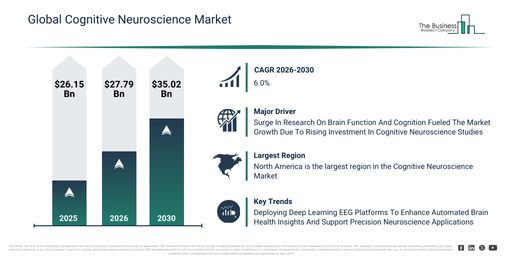
    The cognitive neuroscience market size has experienced strong growth in recent years. It is forecast to increase from $26.15 billion in 2025 to $27.79 billion in 2026, at a compound annual growth rate (CAGR) of 6.3%. This expansion in the past can be attributed to the increasing adoption of neuroimaging techniques, growing investment in brain research, the rising prevalence of neurological disorders, the expansion of academic research initiatives, and the development of advanced imaging technologies.

    The cognitive neuroscience market is projected to experience robust expansion over the coming years, reaching a valuation of $35.02 billion by 2030, driven by a compound annual growth rate (CAGR) of 6.0%. This anticipated growth during the forecast period is fueled by several factors, including the increasing integration of artificial intelligence and machine learning within the field, a rise in financial backing from both public and private sectors, heightened demand for personalized medicine applications, the spread of portable and non-invasive imaging devices, and enhanced cooperation between pharmaceutical companies and research institutions. Key developments expected during this period encompass technological leaps in functional and multimodal imaging, breakthroughs in real-time brain monitoring systems, the advancement of neuroinformatics and big data integration, progress in personalized treatment options, and significant investment in cognitive neuroscience applications particularly for psychiatry.

    Download A Free Sample Report For Comprehensive Market Insights:

    https://www.thebusinessresearchcompany.com/sample.aspx?id=30560&type=smp&utm_source=Blogs&utm_medium=Paid&utm_campaign=Jul_PR

    Cognitive Neuroscience Market Growth Factors Supporting Long-Term Expansion

    The continually expanding investigation into brain function and cognition is anticipated to boost the cognitive neuroscience market in the future. This growth in research signifies a greater volume of scientific endeavors, financial backing, and project engagement aimed at deepening comprehension of the neural mechanisms underpinning perception, memory, attention, language, decision-making, and other related cognitive processes. Such research endeavors are proliferating as governments and public bodies increasingly designate neuroscience as a crucial scientific and health priority. Cognitive neuroscience plays a vital role in supporting studies on brain function and cognition by providing the necessary experimental instruments, analytical methodologies, training programs, and collaborative research structures essential for investigators to execute and disseminate their neuroscience findings. For illustration, in December 2023, the NIH BRAIN Initiative, a US-based government program, allocated funds to over 150 new neuroscience research projects, totaling more than $220 million. This marked an increase from 130 projects and $180 million in 2022, reflecting a 15.4% rise in project numbers and a 22.2% increase in funding year-over-year. Consequently, the escalating research focused on brain function and cognition is a primary driver for the expansion of the cognitive neuroscience market.

    Cognitive Neuroscience Market Segmentation And Category Breakdown

    The cognitive neuroscience market covered in this report is segmented –

    1) By Type: Magnetic Resonance Imaging (MRI), Functional Magnetic Resonance Imaging (fMRI), Positron Emission Tomography (PET), Magnetoencephalography (MEG), Encephalography (EEC), Near Infrared Spectroscopy (NIRS), Single Photon Emission Computed Tomography (SPECT)

    2) By Technology: Neuroimaging Technology, Electrophysiological Monitoring Technology, Neurostimulation Technology, Digital And Software-Based

    3) By Application: Brain Imaging, Neurological Research, Neurological Disorders, Psychiatry

    4) By End User: Pharmaceutical Companies, Clinical And Research Laboratories, Academic Research Institutes, Hospitals And Pathology Laboratories, Other End Users

    Subsegments:

    1) By Magnetic Resonance Imaging (MRI): Structural Imaging, Diffusion Imaging, Spectroscopy Imaging, Perfusion Imaging

    2) By Functional Magnetic Resonance Imaging (fMRI): Task-Based Imaging, Resting-State Imaging, Connectivity Analysis, Perfusion Functional Imaging

    3) By Positron Emission Tomography (PET): Neuroreceptor Imaging, Metabolic Imaging, Blood Flow Imaging, Neuroinflammation Imaging

    4) By Magnetoencephalography (MEG): Source Localization, Functional Mapping, Connectivity Analysis, Event-Related Analysis

    5) By Encephalography (EEC): Routine Recording, Ambulatory Recording, Sleep Study, Evoked Potentials

    6) By Near Infrared Spectroscopy (NIRS): Continuous Wave Imaging, Frequency Domain Imaging, Time-Resolved Imaging, Functional Monitoring

    7) By Single Photon Emission Computed Tomography (SPECT): Perfusion Imaging, Neuroreceptor Imaging, Metabolic Imaging, Blood Flow Imaging

    Cognitive Neuroscience Market Industry Trends Shaping Future Revenue Growth

    Leading companies within the cognitive neuroscience market are prioritizing the implementation of advanced deep learning EEG platforms, including large neural model platforms, aimed at refining brain signal analysis, augmenting cognitive monitoring, and facilitating the early identification of neurological disorders. These large neural model platforms represent computational architectures or systems developed to build, train, deploy, and oversee extensive neural network models, primarily utilized in artificial intelligence (AI) and machine learning (ML) contexts. An illustrative example is BrainScope Inc., a US-based neurotechnology firm, which introduced its sophisticated EEG-based Large Neural Model deep learning platform in June 2025. This platform incorporates automated EEG interpretation powered by deep learning, extends clinical condition coverage to include concussion, stroke, and early Alzheimer’s detection, and improves real-time biomarker extraction to aid precision diagnostics and clinical trials. It empowers clinicians and researchers to acquire clinically relevant insights into brain function more rapidly, while lessening the need for expert quantitative EEG (qEEG) interpretation. This release signifies a substantial technological stride, as it integrates AI-driven EEG analytics with scalable clinical applications, thereby connecting advancements in neurotechnology with enhanced patient care and research effectiveness.

    Cognitive Neuroscience Market Competitive Analysis Of Major Industry Participants

    Major companies operating in the cognitive neuroscience market are Magstim Company Limited, Philips International B.V., GE HealthCare Technologies Inc., Bruker Corporation, United Imaging Healthcare Co. Ltd., Brainbox Ltd., iMotions A/S, Blackrock Neurotech LLC, Advanced Brain Monitoring Inc., Compumedics Limited, BrainGate Inc., NeuroBehavioral Systems Inc., Neurospec AG, Emotiv Inc., Cogstate Ltd., Akili Interactive Labs Inc., MindMaze SA, Brain Products GmbH, Cambridge Cognition Ltd., ANT Neuro B.V., Canon Medical Systems Corporation

    Access The Complete Cognitive Neuroscience Market Report:

    https://www.thebusinessresearchcompany.com/report/cognitive-neuroscience-market-report?utm_source=Blogs&utm_medium=Paid&utm_campaign=Jul_PR

    Cognitive Neuroscience Market Regional Distribution: Which Areas Drive Market Expansion?

    North America was the largest region in the cognitive neuroscience market in 2025. Asia-Pacific is expected to be the fastest-growing region in the forecast period. The regions covered in the cognitive neuroscience market report are Asia-Pacific, South East Asia, Western Europe, Eastern Europe, North America, South America, Middle East, Africa.

    Get in touch with us:

    The Business Research Company: https://www.thebusinessresearchcompany.com/

    Americas: +1 310-496-7795

    Asia: +44 7882 955267 & +91 8897263534

    Europe: +44 7882 955267

    Email us at: marketing@tbrc.info

    Follow us on:

    LinkedIn: https://in.linkedin.com/company/the-business-research-company

    YouTube: https://www.youtube.com/channel/UC24_fI0rV8cR5DxlCpgmyFQ

    Global Market Model: https://www.thebusinessresearchcompany.com/global-market-model
  • Cloud Medical Imaging Platform Market Outlook Highlights The Next Major Growth Opportunities

    Cloud Medical Imaging Platform Market Outlook Highlights The Next Major Growth Opportunities

    Through market attractiveness analysis, total addressable market evaluation, company benchmarking matrices, interactive Excel dashboards, expanded supply chain intelligence, emerging startup coverage, and detailed product insights, The Business Research Company’s 2026 market reports provide more actionable and strategically valuable research.

    Cloud Medical Imaging Platform Market Size Outlook: How Fast Will Revenue Grow Through 2030?

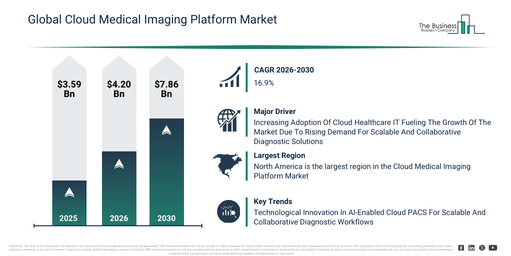
    The cloud medical imaging platform market has experienced significant expansion recently. Projections indicate it will expand from $3.59 billion in 2025 to reach $4.20 billion by 2026, exhibiting a compound annual growth rate (CAGR) of 17.6%. Historically, this increase can be linked to factors such as the rising adoption of cloud-based healthcare IT systems, an increasing need for remote access to medical images, a surge in imaging volume within hospitals and diagnostic centers, the spread of telemedicine and teleradiology services, and the escalating requirement for cost-effective imaging storage solutions.

    The cloud medical imaging platform market is projected to experience substantial expansion over the coming years, reaching $7.86 billion by 2030, demonstrating a compound annual growth rate (CAGR) of 16.9%. This anticipated growth during the forecast period is fueled by several factors, including the increasing adoption of AI-powered imaging tools, a shift towards hybrid cloud deployment models, a greater need for multi-facility image sharing and collaborative efforts, the expansion of healthcare digitalization projects in developing nations, and a stronger emphasis on automating workflows within radiology departments. Key trends expected over the forecast period encompass progress in AI-driven cloud imaging analytics, technological breakthroughs in zero-footprint medical image viewers, enhancements in vendor-neutral archive cloud systems, ongoing research and development in secure blockchain-based imaging exchange, and novel mobile-compatible cloud imaging applications.

    Download A Free Sample Report For Comprehensive Market Insights:

    https://www.thebusinessresearchcompany.com/sample.aspx?id=30557&type=smp&utm_source=Blogs&utm_medium=Paid&utm_campaign=Jul_PR

    #Cloud Medical Imaging Platform Market Growth Drivers And Industry Catalysts

    The increasing adoption of cloud healthcare IT is projected to drive the expansion of the cloud medical imaging platform market moving forward. This rising trend involves the extensive integration of internet-based computing services for storing, managing, and processing medical data remotely, as opposed to using local servers. Advancements in cloud computing infrastructure are fostering this uptake of cloud healthcare IT, offering benefits like scalable storage, heightened data security, and immediate accessibility for medical professionals. Cloud medical imaging platforms improve diagnostic workflows by enabling the effortless storage, retrieval, and sharing of high-resolution medical images across diverse healthcare facilities and devices. For instance, in September 2025, the Office of the National Coordinator for Health Information Technology, a US-based staff division within the Department of Health and Human Services, indicated that 71% of hospitals utilized predictive AI integrated with electronic health records in 2024, an increase from 66% in 2023. Therefore, the growing adoption of cloud healthcare IT is a primary driver for the growth of the cloud medical imaging platform market.

    Cloud Medical Imaging Platform Market Segments: Where Are The Largest Growth Opportunities?

    The cloud medical imaging platform market covered in this report is segmented –

    1) By Component: Software, Services

    2) By Imaging Modality: X-ray, Computed Tomography (CT), Magnetic Resonance Imaging (MRI), Ultrasound, Nuclear Imaging, Other Imaging Modalities

    3) By Pricing Model: Subscription-Based (Software As A Service), Pay-Per-Use Or Consumption-Based, Hybrid Pricing Models

    4) By Deployment Mode: Public Cloud, Private Cloud, Hybrid Cloud

    5) By End-User: Hospitals, Diagnostic Centers, Research And Academic Institutes, Other End-Users

    Subsegments:

    1) By Software: Picture Archiving And Communication System Software, Radiology Information System Software, Vendor Neutral Archive Software, Enterprise Viewers And Universal Workstations, Image Analysis Software, Telemedicine Platform Software

    2) By Services: Implementation And Integration Services, Training And Education Services, Support And Maintenance Services, Consulting Services, Managed Services

    #Cloud Medical Imaging Platform Market Trends Influencing Long-Term Demand

    Leading entities within the cloud medical imaging platform market are prioritizing advancements in technology, particularly the development of cutting-edge cloud-based Picture Archiving and Communication Systems (PACS) that incorporate artificial intelligence (AI). Such platforms aim to optimize diagnostic processes through capabilities like rapid remote accessibility, automated management of studies, and sophisticated image processing capabilities from diverse locations, which in turn lowers IT infrastructure expenses and enhances operational effectiveness. As an illustration, in November 2023, Royal Philips, a health technology firm based in the Netherlands, introduced HealthSuite Imaging, which is a cloud-native PACS offering running on Amazon Web Services (AWS). This specific platform provides quick remote access for interpreting diagnostics, comprehensive reporting, and AI-powered workflow coordination, empowering healthcare providers to expand their services securely and alleviate the demands of managing on-site IT infrastructure.

    Cloud Medical Imaging Platform Market Major Participants And Competitive Dynamics

    Major companies operating in the cloud medical imaging platform market are FUJIFILM Holdings Corp., GE HealthCare Technologies Inc., Sectra AB, Viz.ai Inc., Aidoc Medical Ltd., Arterys Inc., Lunit Inc., INFINITT Healthcare Co. Ltd., Qure.ai Technologies Pvt. Ltd., Novarad Corporation, RamSoft Inc., Annalise.ai Pty Ltd., Subtle Medical Inc., Gleamer SAS, VUNO Inc., PaxeraHealth Inc., Medixant Sp. z o.o., Medicai Ltd., MedDream UAB, Visbion Ltd., Studycast Inc.

    Access The Complete Cloud Medical Imaging Platform Market Report:

    https://www.thebusinessresearchcompany.com/report/cloud-medical-imaging-platform-market-report?utm_source=Blogs&utm_medium=Paid&utm_campaign=Jul_PR

    Cloud Medical Imaging Platform Market Geographic Landscape: Which Region Dominates Industry Growth?

    North America was the largest region in the cloud medical imaging platform market in 2025. Asia-Pacific is expected to be the fastest-growing region in the forecast period. The regions covered in the cloud medical imaging platform market report are Asia-Pacific, South East Asia, Western Europe, Eastern Europe, North America, South America, Middle East, Africa.

    Get in touch with us:

    The Business Research Company: https://www.thebusinessresearchcompany.com/

    Americas: +1 310-496-7795

    Asia: +44 7882 955267 & +91 8897263534

    Europe: +44 7882 955267

    Email us at: marketing@tbrc.info

    Follow us on:

    LinkedIn: https://in.linkedin.com/company/the-business-research-company

    YouTube: https://www.youtube.com/channel/UC24_fI0rV8cR5DxlCpgmyFQ

    Global Market Model: https://www.thebusinessresearchcompany.com/global-market-model
  • Brain Cancer Market Growth Is Reshaping Competitive Advantage Across The Industry

    Brain Cancer Market Growth Is Reshaping Competitive Advantage Across The Industry

    Delivering more actionable and strategically valuable research, The Business Research Company’s 2026 market reports feature market attractiveness analysis, total addressable market evaluation, company benchmarking matrices, interactive Excel dashboards, expanded supply chain intelligence, emerging startup coverage, and detailed product insights.

    Brain Cancer Market Size Forecast: How Large Could The Market Become By 2030?

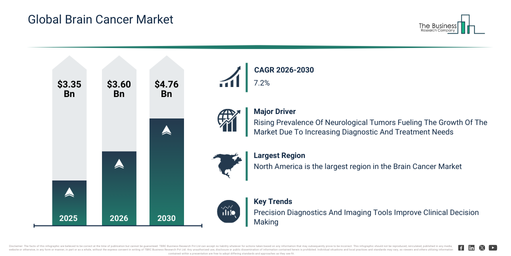
    The market size for brain cancer has experienced robust growth in recent years. It is projected to expand from $3.35 billion in 2025 to $3.60 billion in 2026, exhibiting a compound annual growth rate (CAGR) of 7.5%. This historical growth can be attributed to several factors, including an increase in brain cancer incidence, the growing adoption of neuroimaging techniques, a rising demand for chemotherapy and radiotherapy, expanding access to specialized cancer centers, and increasing healthcare expenditure.

    The brain cancer market is projected for robust expansion over the coming years. This market is predicted to reach $4.76 billion by 2030, exhibiting a compound annual growth rate (CAGR) of 7.2%. Factors contributing to this growth during the forecast period include increasing demand for targeted treatments, greater uptake of immunotherapies, broader application of minimally invasive neurosurgical procedures, a heightened emphasis on early detection, and increased capital allocation in oncology infrastructure. Key trends anticipated during this period encompass advancements in AI-driven diagnostic instruments, the creation of customized medicine solutions, novel combinations in immunotherapy, strides in liquid biopsy technologies, and ongoing research and development efforts in high-precision imaging systems.

    Download A Free Sample Report For Comprehensive Market Insights:

    https://www.thebusinessresearchcompany.com/sample.aspx?id=30544&type=smp&utm_source=Blogs&utm_medium=Paid&utm_campaign=Jul_PR

    Brain Cancer Market Opportunity Drivers: What Is Creating New Revenue Potential?

    The future expansion of the brain cancer market is anticipated to be fueled by the rising occurrence of neurological tumors. These tumors are defined as unusual, frequently malignant growths in the brain or central nervous system, which disrupt neurological functions and demand intricate medical care. The increasing incidence of neurological tumors stems from demographic changes like an aging and expanding population, given that advancing age elevates the likelihood of developing brain cancers. The brain cancer market addresses this heightened prevalence by enhancing diagnostic tools, treatment options, and care services to meet the evolving clinical requirements of the increasing patient base. For example, the American Cancer Society, a US-based non-profit, projected in January 2025 that for the year 2025, approximately 14,040 new cases of brain tumors and other nervous system cancers are anticipated in males and 10,780 in females, alongside an estimated 18,330 total deaths. Consequently, the expanding occurrence of neurological tumors is a primary factor stimulating the growth of the brain cancer market.

    Brain Cancer Market Segments: Where Are The Largest Growth Opportunities?

    The brain cancer market covered in this report is segmented –

    1) By Product Type: Therapeutic Treatments, Diagnostic Imaging, Surgical Devices, Supportive Care Products

    2) By Surgical Treatment: Tumor Resection, Minimally Invasive Surgery, Stereotactic Surgery

    3) By Diagnosis: Imaging Techniques, Biopsy, Molecular Testing, Genetic Testing

    4) By Supportive Care: Rehabilitation, Palliative Care, Counseling, Follow-Up Care

    5) By End User: Hospitals, Specialty Clinics, Research Institutes

    Subsegments:

    1) By Therapeutic Treatments: Chemotherapy Drugs, Targeted Therapy Drugs, Immunotherapy Agents, Radiation Therapy Products, Hormone Therapy Products, Tumor Treating Fields Devices

    2) By Diagnostic Imaging: Magnetic Resonance Imaging Systems, Computed Tomography Scanners, Positron Emission Tomography Systems, Ultrasound Imaging Systems, Nuclear Imaging Systems

    3) By Surgical Devices: Neurosurgical Navigation Systems, Craniotomy Instruments, Neuroendoscopy Devices, Surgical Microscopes, Stereotactic Surgical Equipment

    4) By Supportive Care Products: Pain Management Medications, Anti Nausea Medications, Nutritional Support Products, Rehabilitation Equipment, Symptom Management Products

    Brain Cancer Market Innovation Trends Driving Future Development

    Leading firms within the brain cancer market are prioritizing the creation of sophisticated diagnostic and imaging instruments, including AI-powered MRI segmentation platforms, aiming to enhance clinical judgment and optimize treatment strategies. These AI-driven MRI segmentation platforms are defined as software applications that employ artificial intelligence to automatically pinpoint and outline anatomical features or abnormalities on MRI images, thereby facilitating quicker and more uniform diagnosis and treatment formulation. An example of this is seen in July 2025, when Cortechs.ai, a US-based medical imaging software company, introduced NeuroQuant Brain Tumor. This product features improved AI-driven MRI segmentation models, providing automated volumetric quantification and segmentation for metastasis/meningioma, which boosts radiologist efficiency and diagnostic consistency over manual methods, along with cloud deployment and PACS integration for quick scalability. Through its delivery of objective segmentations and volumetric reports, this advanced technology enhances the effectiveness and standardization for radiologists, neurosurgeons, and neuro-oncologists, concurrently saving time and increasing clinical consistency and diagnostic certainty. This allows clinicians to directly contribute to better patient outcomes by observing tumor alterations over time and acquiring critical insights into treatment effectiveness and the progression of the disease.

    Brain Cancer Market Major Participants And Competitive Dynamics

    Major companies operating in the brain cancer market are Providence Health & Services, Ascension Health, Trinity Health, Mayo Clinic, Memorial Sloan Kettering Cancer Center, Cleveland Clinic, The Mount Sinai Hospital, The University of Texas MD Anderson Cancer Center, CommonSpirit Health, City of Hope National Medical Center, Stanford Health Care, Apollo Hospitals Enterprise Limited, Elekta AB, H. Lee Moffitt Cancer Center & Research Institute Inc., Roswell Park Comprehensive Cancer Center, Fred Hutchinson Cancer Center, Fortis Healthcare Limited, Dana-Farber Cancer Institute Inc., The Johns Hopkins Hospital, The Regents of the University of California

    Access The Complete Brain Cancer Market Report:

    https://www.thebusinessresearchcompany.com/report/brain-cancer-market-report?utm_source=Blogs&utm_medium=Paid&utm_campaign=Jul_PR

    Brain Cancer Market Regional Analysis: Which Region Leads By Revenue?

    North America was the largest region in the brain cancer market in 2025. Asia-Pacific is expected to be the fastest-growing region in the forecast period. The regions covered in the brain cancer market report are Asia-Pacific, South East Asia, Western Europe, Eastern Europe, North America, South America, Middle East, Africa.

    Get in touch with us:

    The Business Research Company: https://www.thebusinessresearchcompany.com/

    Americas: +1 310-496-7795

    Asia: +44 7882 955267 & +91 8897263534

    Europe: +44 7882 955267

    Email us at: marketing@tbrc.info

    Follow us on:

    LinkedIn: https://in.linkedin.com/company/the-business-research-company

    YouTube: https://www.youtube.com/channel/UC24_fI0rV8cR5DxlCpgmyFQ

    Global Market Model: https://www.thebusinessresearchcompany.com/global-market-model
  • Artificial Intelligence (AI)-Driven Hospital Supply Waste Monitor Market Forecast Reveals Where Future Industry Value Will Be Created

    Artificial Intelligence (AI)-Driven Hospital Supply Waste Monitor Market Forecast Reveals Where Future Industry Value Will Be Created

    Enhanced with market attractiveness analysis, total addressable market evaluation, company benchmarking matrices, interactive Excel dashboards, expanded supply chain intelligence, emerging startup coverage, and detailed product insights, The Business Research Company’s 2026 market reports deliver more actionable and strategically valuable research.

    Artificial Intelligence (AI)-Driven Hospital Supply Waste Monitor Market Size, Value And Growth Trends Through 2030

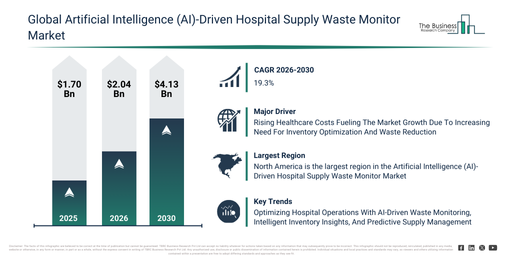
    The artificial intelligence (AI)-driven hospital supply waste monitor market has witnessed rapid expansion in recent years. Projections indicate its size will increase from $1.70 billion in 2025 to $2.04 billion in 2026, demonstrating a compound annual growth rate (CAGR) of 19.6%. This historical growth is attributable to several factors, including the rising integration of AI in healthcare operations, a heightened imperative to minimize medical supply waste, an elevated emphasis on cost optimization within hospitals, broader utilization of predictive analytics, and the increasing deployment of inventory monitoring solutions.

    The artificial intelligence (AI)-driven hospital supply waste monitor market is projected to experience substantial expansion in the coming years. This market is anticipated to reach a valuation of $4.13 billion by 2030, exhibiting a compound annual growth rate (CAGR) of 19.3%. Key drivers for this growth throughout the projected timeframe include increased capital allocation towards healthcare IT infrastructure, the escalating incorporation of AI into hospital management frameworks, wider uptake of cloud-powered supply surveillance platforms, the proliferation of remote tracking and intelligent inventory solutions, and a heightened focus on environmental sustainability and waste minimization efforts. Significant developments expected during the forecast period encompass technological progress in machine learning and AI algorithms, breakthroughs in real-time inventory tracking hardware, extensive research and innovation in predictive analytics tailored for waste reduction, the creation of automated reporting and dashboard functionalities, and enhancements in interconnected healthcare IT and inventory management systems.

    Download A Free Sample Report For Comprehensive Market Insights:

    https://www.thebusinessresearchcompany.com/sample.aspx?id=30522&type=smp&utm_source=Blogs&utm_medium=Paid&utm_campaign=Jul_PR

    Artificial Intelligence (AI)-Driven Hospital Supply Waste Monitor Market Expansion Supported By Key Demand Factors

    The anticipated expansion of the artificial intelligence (AI)-driven hospital supply waste monitor market is fueled by escalating healthcare expenses. These escalating costs represent a continuous surge in expenditures necessary for providing medical services and maintaining hospital operations, encompassing personnel, equipment, and medical supplies, thereby imposing financial strain on healthcare systems. This increase in healthcare spending is attributed to an aging demographic demanding more rigorous treatments for chronic ailments like heart disease and diabetes. The artificial intelligence (AI)-driven hospital supply waste monitor addresses healthcare costs by minimizing superfluous supply waste, enhancing inventory management, and assisting providers in regulating total outlays. A notable illustration comes from June 2025, where the US-based government health expenditure authority, the Centers for Medicare and Medicaid Services (CMS), reported that in 2023, hospital care expenditures rose by 10.4% to reach $1.52 trillion, and overall national health spending expanded by 7.5% to $4.9 trillion compared to 2022. Consequently, the escalating healthcare costs are serving as a significant impetus for the expansion of the artificial intelligence (AI)-driven hospital supply waste monitor market.

    Artificial Intelligence (AI)-Driven Hospital Supply Waste Monitor Market Segment Analysis And Revenue Opportunities

    The artificial intelligence (AI)-driven hospital supply waste monitor market covered in this report is segmented –

    1) By Component: Software, Hardware, Services

    2) By Deployment Mode: On-Premises, Cloud-Based

    3) By Application: Inventory Management, Waste Tracking, Cost Reduction, Compliance Monitoring, Other Applications

    4) By End-User: Hospitals, Clinics, Ambulatory Surgical Centers, Other End-Users

    Subsegments:

    1) By Software: Electronic Health Record Integration, Predictive Analytics Platforms, Risk Scoring Systems, Clinical Decision Support Tools

    2) By Hardware: Servers, Sensors, Monitoring Devices, Data Storage Devices

    3) By Services: Data Analytics Services, Predictive Modeling Services, Integration And Deployment Services, Training And Support Services, Monitoring And Reporting Services

    Artificial Intelligence (AI)-Driven Hospital Supply Waste Monitor Market Growth Trends Influencing Competitive Dynamics

    Leading companies within the artificial intelligence (AI)-driven hospital supply waste monitor market are prioritizing the development of sophisticated technologies, notably predictive usage and waste reduction analytics, to boost supply chain transparency, minimize waste, and decrease operational expenses in healthcare facilities. These predictive usage and waste reduction analytics represent AI systems that process historical and live data to project inventory demands, recognize consumption patterns, and autonomously alert staff to possible overstock or waste situations, leading to more informed procurement and effective resource distribution. For example, in April 2024, SmartPAR.AI Inc., a US-based healthtech software provider, launched an AI-driven solution aimed at transforming hospital inventory management and reducing product waste. The platform integrates machine learning, alongside predictive usage and waste reduction analytics, to supervise available supplies, anticipate future demand, and identify discrepancies that could contribute to waste.

    Artificial Intelligence (AI)-Driven Hospital Supply Waste Monitor Market Leading Players Shaping Industry Direction

    Major companies operating in the artificial intelligence (AI)-driven hospital supply waste monitor market are Cardinal Health Inc., Oracle Corporation, Becton Dickinson and Company, Owens & Minor Inc., Arvato AG, Zebra Technologies Corporation, Getinge AB, Palantir Technologies Inc., Omnicell Inc., Manhattan Associates Inc., Symplr Inc., Global Healthcare Exchange LLC, Tecsys Inc., Terso Solutions Inc., LogiTag Systems Ltd., Spikewell Inc., Softlabs Group Inc., Stanley Healthcare, Z5 Inventory Inc., IDENTI Medical Ltd.

    Access The Complete Artificial Intelligence (AI)-Driven Hospital Supply Waste Monitor Market Report:

    https://www.thebusinessresearchcompany.com/report/artificial-intelligence-ai-driven-hospital-supply-waste-monitor-market-report?utm_source=Blogs&utm_medium=Paid&utm_campaign=Jul_PR

    Artificial Intelligence (AI)-Driven Hospital Supply Waste Monitor Market Regional Analysis: Which Region Leads By Revenue?

    North America was the largest region in the artificial intelligence (AI)-driven hospital supply waste monitor market in 2025. Asia-Pacific is expected to be the fastest-growing region in the forecast period. The regions covered in the artificial intelligence (AI)-driven hospital supply waste monitor market report are Asia-Pacific, South East Asia, Western Europe, Eastern Europe, North America, South America, Middle East, Africa.

    Get in touch with us:

    The Business Research Company: https://www.thebusinessresearchcompany.com/

    Americas: +1 310-496-7795

    Asia: +44 7882 955267 & +91 8897263534

    Europe: +44 7882 955267

    Email us at: marketing@tbrc.info

    Follow us on:

    LinkedIn: https://in.linkedin.com/company/the-business-research-company

    YouTube: https://www.youtube.com/channel/UC24_fI0rV8cR5DxlCpgmyFQ

    Global Market Model: https://www.thebusinessresearchcompany.com/global-market-model
  • Artificial Intelligence (AI)-Driven Hospital Readmission Predictor Market Growth Through 2030 Creates New Strategic Opportunities

    Artificial Intelligence (AI)-Driven Hospital Readmission Predictor Market Growth Through 2030 Creates New Strategic Opportunities

    Through market attractiveness analysis, total addressable market evaluation, company benchmarking matrices, interactive Excel dashboards, expanded supply chain intelligence, emerging startup coverage, and detailed product insights, The Business Research Company’s 2026 market reports provide more actionable and strategically valuable research.

    Artificial Intelligence (AI)-Driven Hospital Readmission Predictor Market CAGR Analysis And Future Market Development

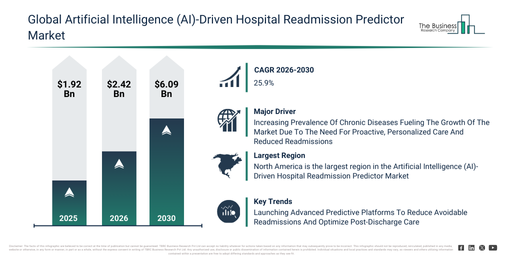
    The artificial intelligence (AI)-driven hospital readmission predictor market has seen rapid expansion in recent years. It is anticipated to grow from $1.92 billion in 2025 to $2.42 billion in 2026, demonstrating a compound annual growth rate (CAGR) of 26.2%. The growth observed in the historic period is attributable to the increasing adoption of AI in healthcare, a growing demand to reduce hospital readmissions, the rising availability of electronic health records, the expansion of predictive analytics usage, and an increasing focus on patient outcomes.

    The artificial intelligence (AI)-driven hospital readmission predictor market is anticipated to undergo significant expansion in the coming years. It is projected to achieve a size of $6.09 billion by 2030, growing at a compound annual growth rate (CAGR) of 25.9%. This expansion throughout the forecast period is attributable to increasing investments in healthcare IT infrastructure, the growing incorporation of clinical decision support systems, the rising adoption of cloud-based analytics platforms, the broadening scope of remote patient monitoring tools, and an enhanced focus on value-based care models. Key trends during this period are expected to include technological advancements in machine learning models, innovations in real-time patient monitoring, research and developments in natural language processing, the creation of explainable AI specifically for healthcare, and improvements in interoperable healthcare IT systems.

    Download A Free Sample Report For Comprehensive Market Insights:

    https://www.thebusinessresearchcompany.com/sample.aspx?id=30521&type=smp&utm_source=Blogs&utm_medium=Paid&utm_campaign=Jul_PR

    #Artificial Intelligence (AI)-Driven Hospital Readmission Predictor Market Growth Drivers And Industry Catalysts

    The growing incidence of chronic ailments is projected to boost the artificial intelligence (AI)-driven hospital readmission predictor market. Chronic diseases, defined as enduring health issues such as diabetes, heart disease, and arthritis, typically progress slowly and necessitate ongoing medical attention and lifestyle adjustments to manage symptoms and avert complications. The rise in these conditions is largely attributed to unhealthy lifestyle choices, including inadequate diet, physical inactivity, and smoking, which escalate the likelihood of ailments like diabetes, heart disease, and obesity. Artificial intelligence (AI)-driven hospital readmission predictors play a crucial role in chronic disease management by analyzing patient information to pinpoint individuals at high risk of readmission. They enhance patient outcomes by facilitating proactive interventions, tailored care plans, and timely follow-ups, thereby preventing complications and shortening hospital stays. For instance, in June 2024, the National Health Service, a UK-based government department, reported that 3,615,330 individuals registered with a general practitioner (GP) were diagnosed with non-diabetic hyperglycemia or pre-diabetes in 2023, an 18% increase from 3,065,825 cases in 2022. Consequently, the increasing prevalence of chronic diseases is fueling the expansion of the artificial intelligence (AI)-driven hospital readmission predictor market.

    Artificial Intelligence (AI)-Driven Hospital Readmission Predictor Market Segmentation And Category Breakdown

    The artificial intelligence (AI)-driven hospital readmission predictor market covered in this report is segmented –

    1) By Component: Software, Hardware, Services

    2) By Deployment Mode: On-Premises, Cloud

    3) By Application: Patient Risk Assessment, Care Management, Clinical Decision Support, Population Health Management, Other Applications

    4) By End-User: Hospitals, Clinics, Ambulatory Surgical Centers, Other End-Users

    Subsegments:

    1) By Software: Electronic Health Record Integration, Predictive Analytics Platforms, Risk Scoring Systems, Clinical Decision Support Tools

    2) By Hardware: Servers, Sensors, Monitoring Devices, Data Storage Devices

    3) By Services: Data Analytics Services, Predictive Modeling Services, Integration And Deployment Services, Training And Support Services, Monitoring And Reporting Services

    #Artificial Intelligence (AI)-Driven Hospital Readmission Predictor Market Trends Influencing Long-Term Demand

    Major companies operating in the artificial intelligence (AI)-driven hospital readmission predictor market are prioritizing the development of sophisticated solutions, such as advanced predictive modeling, to pinpoint high-risk patients, enable swift interventions, and optimize post-discharge care. Advanced predictive modeling entails utilizing complex statistical algorithms and machine learning techniques on historical and real-time data to uncover intricate patterns and generate highly accurate forecasts of future outcomes. For instance, in July 2025, Innovaccer Inc., a US-based healthcare AI company, introduced its AI-Powered Readmissions Management Solution, which integrates advanced predictive modeling to identify avoidable readmissions among Medicare, Medicaid, and uninsured populations. The platform also delivers unified 360-degree patient views, agentic AI tools like Care Management Copilot and Pre-Call Coordinator Agent for automating workflows, and benchmark intelligence for planning proactive interventions. This solution supports healthcare providers in decreasing readmission rates, enhancing resource allocation, and improving overall patient outcomes.

    Artificial Intelligence (AI)-Driven Hospital Readmission Predictor Market Competitive Analysis Of Major Industry Participants

    Major companies operating in the artificial intelligence (AI)-driven hospital readmission predictor market are Oracle Corporation, Siemens Healthineers AG, Cognizant Technology Solutions Corp., Epic Systems Corporation, SAS Institute Inc., Veradigm Inc., Merative LLP, Health Catalyst Inc., Lumeris Inc., Innovaccer Inc., Optum Inc., H2O.ai Inc., Healthfirst Inc., Qventus Inc., Lightbeam Health Solutions Inc., HealthEC LLC, Collective Medical Technologies Inc., CarePredict Inc., HBI Solutions Inc., CloudMedx

    Access The Complete Artificial Intelligence (AI)-Driven Hospital Readmission Predictor Market Report:

    https://www.thebusinessresearchcompany.com/report/artificial-intelligence-ai-driven-hospital-readmission-predictor-market-report?utm_source=Blogs&utm_medium=Paid&utm_campaign=Jul_PR

    Artificial Intelligence (AI)-Driven Hospital Readmission Predictor Market Geographic Distribution And Regional Opportunities

    North America was the largest region in the artificial intelligence (AI)-driven hospital readmission predictor market in 2025. Asia-Pacific is expected to be the fastest-growing region in the forecast period. The regions covered in the artificial intelligence (AI)-driven hospital readmission predictor market report are Asia-Pacific, South East Asia, Western Europe, Eastern Europe, North America, South America, Middle East, Africa.

    Get in touch with us:

    The Business Research Company: https://www.thebusinessresearchcompany.com/

    Americas: +1 310-496-7795

    Asia: +44 7882 955267 & +91 8897263534

    Europe: +44 7882 955267

    Email us at: marketing@tbrc.info

    Follow us on:

    LinkedIn: https://in.linkedin.com/company/the-business-research-company

    YouTube: https://www.youtube.com/channel/UC24_fI0rV8cR5DxlCpgmyFQ

    Global Market Model: https://www.thebusinessresearchcompany.com/global-market-model
  • Artificial Intelligence (AI) Tele-Oncology Radiation Dose Scheduler Market Size Projected To Increase From $0.99 Billion To $2.28 Billion During The Forecast Period

    Artificial Intelligence (AI) Tele-Oncology Radiation Dose Scheduler Market Size Projected To Increase From $0.99 Billion To $2.28 Billion During The Forecast Period

    Delivering more actionable and strategically valuable research, The Business Research Company’s 2026 market reports feature market attractiveness analysis, total addressable market evaluation, company benchmarking matrices, interactive Excel dashboards, expanded supply chain intelligence, emerging startup coverage, and detailed product insights.

    Artificial Intelligence (AI) Tele-Oncology Radiation Dose Scheduler Market Expansion From $0.99 Billion In 2026 To $2.28 Billion In 2030

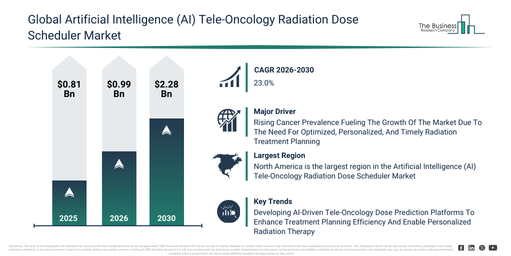
    The artificial intelligence (AI) tele-oncology radiation dose scheduler market has experienced significant growth in recent years. This market is projected to expand from $0.81 billion in 2025 to $0.99 billion in 2026, achieving a compound annual growth rate (CAGR) of 23.3%. The growth observed in the historical period can be attributed to a confluence of factors, including the increasing need for remote cancer treatment planning, the rising adoption of tele-oncology platforms, a growing demand for precise radiation dose calculation, the expanding use of AI in oncology decision support, a worldwide increase in cancer incidence, the ongoing digital transformation within hospitals, the increasing deployment of cloud-based medical systems, an escalating requirement for workflow automation in radiotherapy, an enhanced focus on minimizing treatment errors, and the growing uptake of smart oncology scheduling tools.

    The artificial intelligence (AI) tele-oncology radiation dose scheduler market size is projected to experience substantial expansion in the coming years. This market is anticipated to reach $2.28 billion by 2030, demonstrating a compound annual growth rate (CAGR) of 23.0%. The growth during this forecast period can be attributed to several factors, including the expansion of tele-oncology networks, increased adoption of AI-enabled treatment planning platforms, a rising demand for automated dose calculation systems, the uptake of cloud-based oncology scheduling modules, the deployment of predictive oncology algorithms, the development of remote radiotherapy review tools, a growing demand for precision-based cancer care, the integration of AI tools into oncology departments, strategic partnerships between AI vendors and cancer centers, and the growing acceptance of tele-radiation workflows. Concurrently, major trends expected in the forecast period involve advancements in AI-driven radiotherapy dose prediction, progress in cloud-based oncology scheduling platforms, developments in real-time dose optimization engines, innovations in automated treatment planning systems, breakthroughs in predictive oncology algorithms, novelties in virtual radiation oncology workflows, the integration of tele-oncology with hospital information systems, the merging of AI dose schedulers with imaging platforms, the incorporation of remote dose-review tools for oncologists, and the establishment of multi-center tele-radiation networks.

    Download A Free Sample Report For Comprehensive Market Insights:

    https://www.thebusinessresearchcompany.com/sample.aspx?id=30520&type=smp&utm_source=Blogs&utm_medium=Paid&utm_campaign=Jul_PR

    Artificial Intelligence (AI) Tele-Oncology Radiation Dose Scheduler Market Opportunity Drivers: What Is Creating New Revenue Potential?

    The increasing incidence of cancer is anticipated to drive the expansion of the artificial intelligence (AI) tele-oncology radiation dose scheduler market in the future. This disease is defined by the unrestrained proliferation and dissemination of atypical cells, which can harm adjacent tissues and organs if left untreated. Its prevalence is growing due to lifestyle factors like inadequate nutrition, smoking, alcohol intake, and exposure to environmental contaminants, which heighten the risk of developing various forms of cancer. Artificial intelligence (AI) tele-oncology radiation dose schedulers assist in cancer management by optimizing and customizing radiation treatment regimens through remote, data-driven analysis. These tools enhance patient results by guaranteeing precise dosing, minimizing treatment postponements, and facilitating uniform care across different geographical areas. For example, data from NHS Digital, a UK government body, indicated 354,820 new cancer diagnoses in England in 2023 by October 2025, with an average of 972 daily diagnoses. This marked an increase of 8,605 cases from 2022. Prostate cancer was the most prevalent diagnosis, accounting for 58,137 new cases, showing a 6% rise in registrations compared to the prior year. Consequently, the increasing prevalence of cancer is fueling the expansion of the artificial intelligence (AI) tele-oncology radiation dose scheduler market.

    Artificial Intelligence (AI) Tele-Oncology Radiation Dose Scheduler Market Segment Outlook: Which Categories Are Expanding The Fastest?

    The artificial intelligence (AI) tele-oncology radiation dose scheduler market covered in this report is segmented –

    1) By Component: Software, Hardware, Services

    2) By Technology: Machine Learning Algorithms, Natural Language Processing, Computer Vision, Predictive Analytics

    3) By Deployment Mode: On-Premise (Local Installation), Cloud-Based (SaaS), Hybrid Deployment

    4) By Application: Auto-Contouring And Segmentation (OAR Or Target), Treatment Plan Generation And Optimization, Dose Prediction And Quality Assurance (QA), Workflow And Resource Scheduling Optimization, Adaptive Radiotherapy Planning

    5) By End-User: Hospitals, Cancer Treatment Centers, Research Institutes, Other End-Users

    Subsegments:

    1) By Software: Analytics And Reporting Software, Recommendation Engine Software, Natural Language Processing Software, Machine Learning Model Management Tools, Computer Vision Software, Integration And API Management Software, Mobile And Web Application Software

    2) By Hardware: AI-Optimized Servers, Edge Computing Devices, Sensors And IoT Devices, Smart Cameras, GPUs And AI Accelerators, Storage Systems, Networking And Connectivity Hardware

    3) By Services: Consulting Services, Implementation And Integration Services, Training And Support Services, Managed AI Services, Maintenance And Upgradation Services, Custom AI Development Services, Data Management And Annotation Services

    Artificial Intelligence (AI) Tele-Oncology Radiation Dose Scheduler Market Innovation Trends Driving Future Development

    Key companies within the AI tele-oncology and radiation therapy market are concentrating on creating sophisticated tools, particularly AI-driven dose prediction systems, to forecast individualized radiation dosages and enhance treatment planning efficiency. These AI-powered dose prediction platforms are software-based tools that process imaging and anatomical information, produce clinically viable three-dimensional dose maps, and facilitate prompt modifications for therapy optimization. For example, in March 2025, MVision AI, a Finland-based health-tech company, introduced Dose+. This AI-enhanced dose prediction platform integrates specialized algorithms for prostate and pelvic lymph node scenarios, customizes dose profiles based on individual patient anatomy, and ensures compatibility with standard treatment planning systems via DICOM for streamlined planning processes. The introduction of Dose+ signifies a considerable technological leap, embedding AI-powered dose forecasting into regular clinical procedures, connecting conventional planning approaches with automated, patient-specific enhancements, and offering medical professionals a scalable, effective tool for accurate, tailored radiation treatment.

    Artificial Intelligence (AI) Tele-Oncology Radiation Dose Scheduler Market Key Companies And Competitive Benchmarking

    Major companies operating in the artificial intelligence (AI) tele-oncology radiation dose scheduler market are IBM Corporation, Siemens Healthineers AG, GE HealthCare Technologies Inc., Koninklijke Philips N.V., Varian Medical Systems Inc., Elekta AB, Shanghai United Imaging Healthcare Co. Ltd., Accuray Incorporated, Brainlab AG, RaySearch Laboratories AB, MIM Software Inc., Sun Nuclear Corp., DeepHealth, Radformation Inc., MVision AI Ltd., Mirada Medical Ltd., ViewRay Inc., Oncora Medical, Enlitic, Optellum Ltd.

    Access The Complete Artificial Intelligence (AI) Tele-Oncology Radiation Dose Scheduler Market Report:

    https://www.thebusinessresearchcompany.com/report/artificial-intelligence-ai-tele-oncology-radiation-dose-scheduler-market-report?utm_source=Blogs&utm_medium=Paid&utm_campaign=Jul_PR

    Artificial Intelligence (AI) Tele-Oncology Radiation Dose Scheduler Market Largest Region By Revenue And Market Share

    North America was the largest region in the AI tele-oncology radiation dose scheduler market in 2025. Asia-Pacific is expected to be the fastest-growing region in the forecast period. The regions covered in the artificial intelligence (AI) tele-oncology radiation dose scheduler market report are Asia-Pacific, South East Asia, Western Europe, Eastern Europe, North America, South America, Middle East, Africa.

    Get in touch with us:

    The Business Research Company: https://www.thebusinessresearchcompany.com/

    Americas: +1 310-496-7795

    Asia: +44 7882 955267 & +91 8897263534

    Europe: +44 7882 955267

    Email us at: marketing@tbrc.info

    Follow us on:

    LinkedIn: https://in.linkedin.com/company/the-business-research-company

    YouTube: https://www.youtube.com/channel/UC24_fI0rV8cR5DxlCpgmyFQ

    Global Market Model: https://www.thebusinessresearchcompany.com/global-market-model